
How to Build a Sales Enablement Content System That Shortens Complex Sales Cycles
Complex sales cycles are not caused only by price or competition. Buyers slow down when they cannot quickly understand the problem, see credible proof or share a clear explanation internally. The strongest sales teams therefore treat content as part of the buying experience, not as a collection of marketing assets.
Build Content Around Decision Friction
Start with the questions that pause a deal. Prospects may need to understand implementation, compare approaches, validate results or explain the choice to colleagues. A dedicated LinkedIn lead-generation landing page keeps the campaign promise, proof and conversion action in one place rather than sending buyers to a general website.
In-person moments can also accelerate understanding. A well-run corporate event for global companies creates space for product demonstrations, stakeholder conversations and a structured next step. Afterwards, a Hyderabad video-editing workflow can turn one expert session into a library of clear sales clips, follow-up videos and platform-ready versions.
Create a Sales Library People Will Actually Use
A useful sales library is not a large folder of old PDFs. It contains short, current assets that match recurring buyer questions. For purpose-led organisations, a health NGO marketing approach in Agartala illustrates why outcome clarity, credible stories and a practical action path matter before asking supporters to commit.
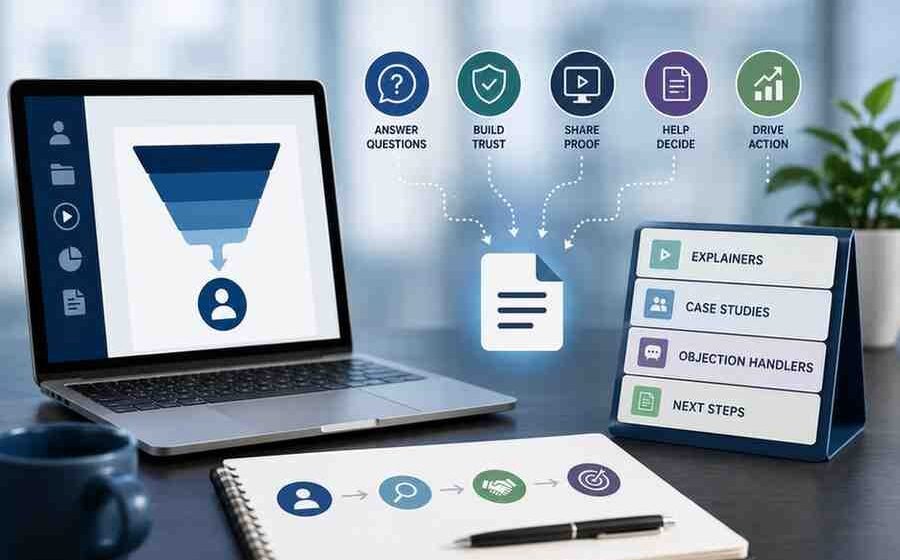
A practical sales-enablement library includes:
- A concise problem-and-solution explainer.
- A proof asset such as a case study, demonstration or testimonial.
- A comparison or FAQ that answers common objections.
- One clear action for the buyer to take next.
Distribute Depth Where Buyers Research
The right content needs credible distribution. Clearly labelled TV9 sponsored content can give a brand room to explain a category without relying on a short promotional line. A ZEE5 Originals sponsorship can add sustained visibility around a longer-form story, while an ABP special feature can create a focused setting for buyers who need more context.
Some offers are difficult to understand until the buyer sees the process. A manufacturing process animation can show sequence, scale and technical detail that sales decks often struggle to convey. These assets should direct viewers to a relevant follow-up page rather than leaving interest without a next step.
Adapt the Story Without Diluting It
Local audiences may need different examples, language or media choices, but the central promise should remain recognisable. Maharashtra-focused sponsored content can give a message regional relevance, while a Hindi television planning guide and a Marathi media planning guide help teams choose formats based on audience behaviour rather than habit.
For consumer brands, the same principle continues through product discovery. FMCG website design should make the product, proof and route to purchase easy to understand before a shopper compares alternatives.
Review What Moves Deals Forward
Track which assets sales teams share, which questions repeat and which content buyers revisit before converting. Improve the gaps first. A sales-enablement content system works when it gives buyers the confidence to continue the conversation—and gives sales teams a clearer way to guide it.