
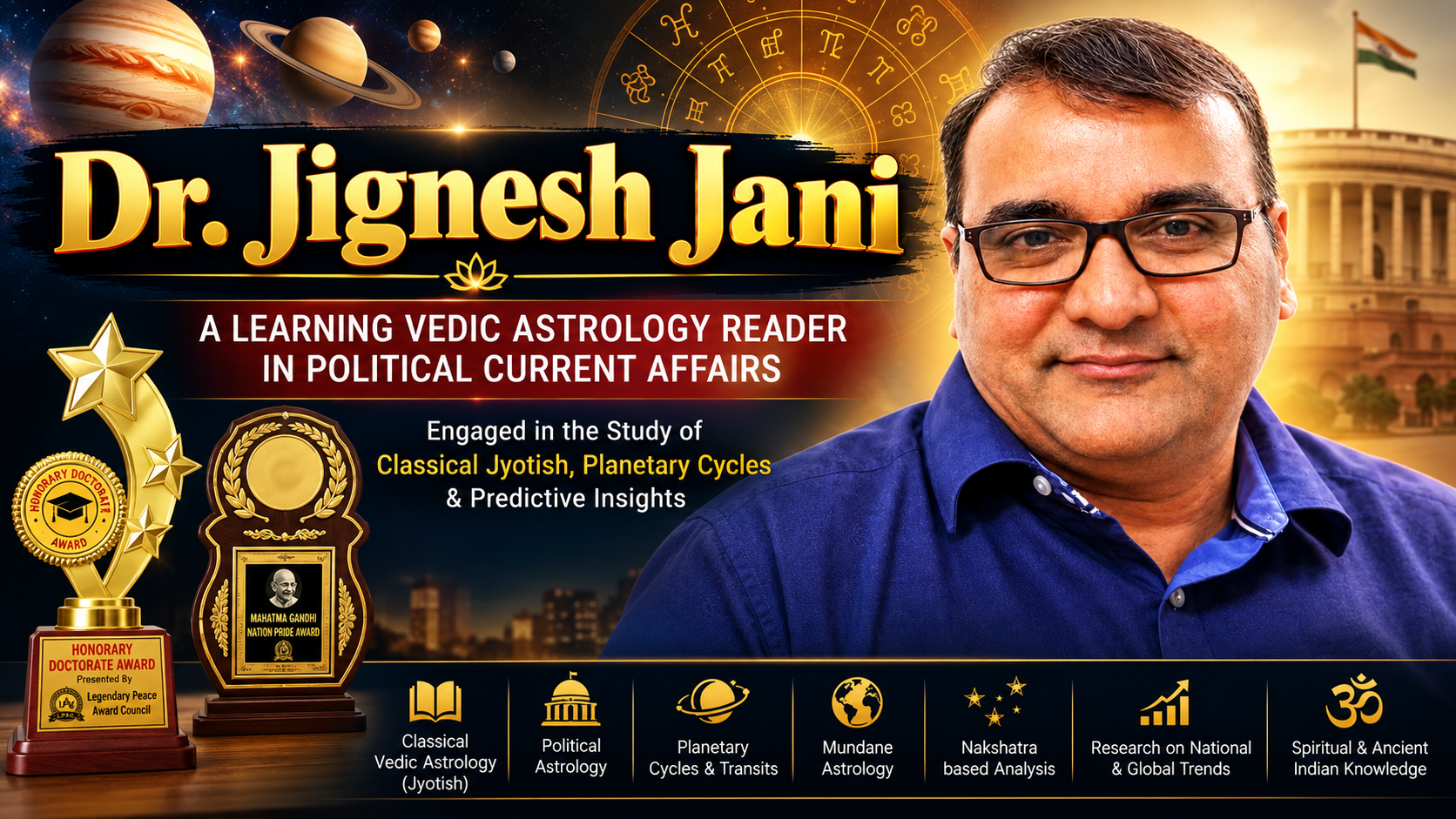
Astrologer Jignesh Jani Shares Views on Planetary Cycles and Global Affairs
Ahmedabad | July 10, 2026: Vedic astrology researcher Jignesh Jani has shared his views on the relationship between planetary cycles and global affairs, explaining that traditional Jyotish interprets celestial movements as symbolic reflections of collective human experiences rather than scientifically established predictions of geopolitical events. He emphasized that astrology should be approached as a cultural and philosophical discipline that complements thoughtful discussion without replacing evidence-based analysis.
According to Jani, Vedic astrology has for centuries examined planetary cycles to understand broader social, political, and economic patterns. He explained that many astrologers currently interpret the Mars–Rahu conjunction, traditionally called Angarak Yoga, as symbolizing heightened strategic activity, increased geopolitical attention, and periods requiring careful leadership. These symbolic interpretations, he said, should not be mistaken for certainty regarding future international developments.
Jani also discussed the Saturn–Neptune alignment, which many practitioners associate with institutional reform, changing political ideologies, evolving alliances, and long-term structural transformation. Such interpretations, he noted, encourage reflection on how nations adapt to changing global circumstances.
Highlighting Jupiter’s traditional significance in Vedic astrology, Jani described it as a symbol of wisdom, ethics, justice, education, and diplomacy. According to many astrologers, Jupiter represents opportunities for dialogue, cooperation, and responsible leadership during periods of uncertainty. He believes these values remain essential as countries address economic challenges, technological progress, environmental concerns, and regional security issues.
While discussing current global affairs, Jani emphasized that real-world developments are shaped by diplomacy, public policy, economic conditions, international law, and decisions taken by governments and global institutions. Astrology, he said, offers symbolic insights that may inspire reflection but cannot determine the course of world events.
“Traditional astrology encourages us to think about broader cycles of change,” Jani said. “However, peace, stability, and prosperity ultimately depend on informed leadership, international cooperation, and constructive dialogue among nations.”
Jani concluded by encouraging readers to respect both India’s ancient astrological traditions and modern evidence-based approaches to understanding global affairs. He expressed hope that continued diplomacy, mutual respect, and collaborative problem-solving will help build a more secure, peaceful, and sustainable future for the international community.